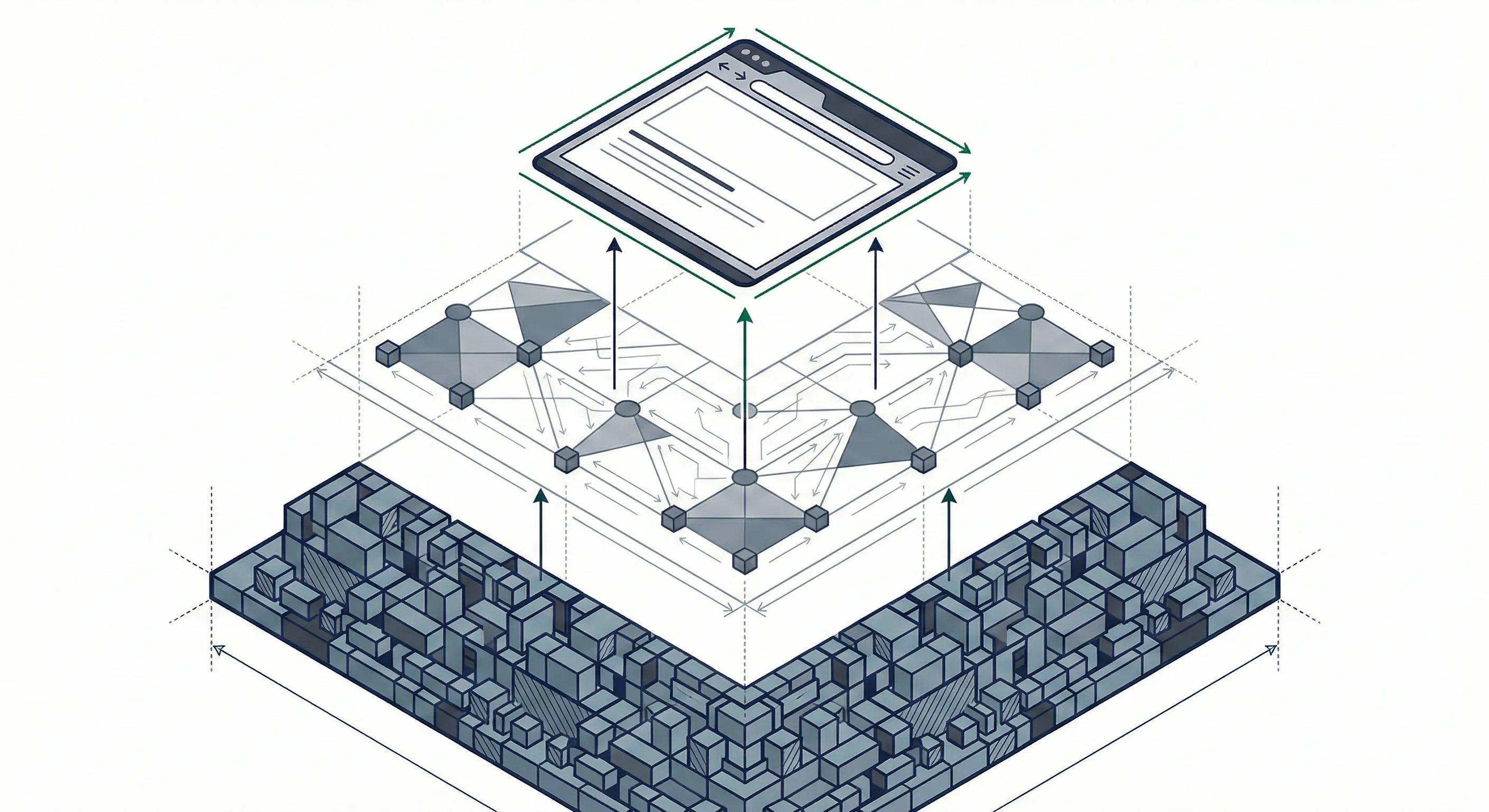
In a context where development teams must deliver faster, more often, and with fewer risks, software architecture is no longer a simple technical choice: it’s a strategic lever. Modular architecture, in particular, stands out as one of the most effective approaches to accelerate production deployments without sacrificing quality.
The problem with monoliths in 2025
For a long time, monolithic architecture was the norm. One codebase, one deployment artifact, one database. For a small team working on a nascent product, this is often sufficient. But as the product grows and the team expands, the monolith becomes a bottleneck.
Every deployment requires compiling, testing, and deploying the entire application — even if the change only affects a tiny part of the system. A failing test in the billing module blocks the delivery of a completely independent feature in the notifications module. Validation cycles get longer, (merge queues) pile up, and developer frustration skyrockets.
In 2025, with expectations of continuous delivery and users demanding constant improvements, this model reaches its limits. Teams that persist with a poorly structured monolith end up delivering monthly what they could deliver weekly.
What is modular architecture?
Modular architecture consists of breaking down a system into independent, self-contained modules, each with clearly defined interfaces. Each module encapsulates its own business logic, data access layer, and tests. Modules communicate with each other through explicit contracts — internal APIs, events, or message queues.
It's important to distinguish modular architecture from microservices. Modularity can very well exist within a monolith. This is referred to as a modular monolith : a single deployed application whose code is organized into highly decoupled modules. This approach offers several advantages of microservices — team independence, isolated testability — without the operational complexity of managing dozens of distributed services.
Fundamental principles
- Separation of concerns : each module covers a distinct business domain (user management, product catalog, billing, etc.).
- Contractual interfaces : modules communicate through defined contracts (internal APIs, events) rather than direct calls between classes.
- Deployment independence : a module can be updated without redeploying the entire system.
- Isolated testability : a module's tests do not require running the entire system — a module can be validated in complete isolation.
- Independent versioning : each module follows its own versioning cycle, allowing asynchronous updates between teams.
How modularity accelerates deployments
Independent CI/CD pipelines
One of the most immediate benefits of modular architecture concerns continuous integration and continuous deployment. When each module has its own build, test, and deployment pipeline, a change to module A does not trigger module B's pipeline.
In practice, this means multiple teams can work in parallel on different modules and deliver their changes independently. Feedback loops are shorter: you know within minutes whether a change is valid, instead of waiting for the full monolith test suite to compile and run. The time between commit and production deployment is drastically reduced.
Incremental deployments
With a modular architecture, you can deliver features without waiting for the entire system to be « ready ». Each module can be deployed as soon as it reaches a stable state, independently of the others.
This approach significantly reduces risk per deployment. Smaller changes are easier to monitor, easier to debug, and easier to roll back if something goes wrong. You can also use (feature flags) at the module level to gradually roll out a new version to a subset of users before enabling it for everyone.
Concrete example: redesign of an e-commerce platform
Consider a common scenario. A company operates an e-commerce platform built as a classic monolith. The product catalog, shopping cart, payment system, and customer account management all coexist in a single codebase. Each deployment takes 45 minutes to compile and 20 minutes for integration tests. The team delivers once a month, and every release is a source of stress.
After a modular redesign, the system is divided into four independent modules: catalog, cart, payments, and accounts. Each module has its own database schema, its own tests, and its own deployment pipeline. Modules communicate through asynchronous events and versioned internal APIs.
The results are tangible. Deployment frequency goes from monthly to weekly — even daily for some modules. Build time per module drops to under five minutes. The production failure rate decreases because each release is smaller and better targeted. Teams work autonomously, without blocking each other.
Where to start?
The transition to a modular architecture doesn't happen overnight, but it can be approached iteratively. Here is a pragmatic roadmap:
- Identify the business domains (
bounded contexts) of your application. What are the major functional responsibilities? Users, products, orders, notifications? - Draw the boundaries : analyze which parts of the code show the most coupling. Where are the most tangled dependencies? That's where decomposition will bring the most value.
- Extract a first low-risk module — for example, notifications or logging. A peripheral module whose extraction does not jeopardize critical functionality.
- Set up a dedicated CI/CD pipeline for this module. Validate that the module can be built, tested, and deployed independently from the rest of the system.
- Measure the impact : deployment frequency, build time, production failure rate. These metrics will guide the next steps of modularization.
Modular architecture is not an end in itself — it's a means to achieve sustainable delivery velocity without compromising system stability or maintainability. At Flowstack, we help technical teams through this type of transition: from auditing the existing architecture to setting up independent deployment pipelines per module. If your monolith is slowing you down, it might be time to talk about it.